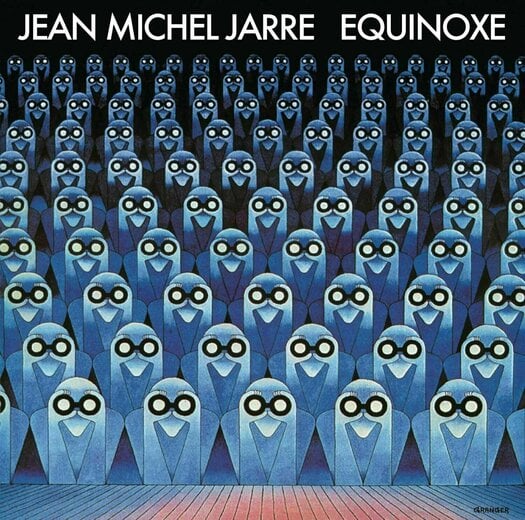
Happy 46th anniversary to Jean-Michel Jarre’s fourth studio album, Equinoxe!
Nowadays this album is regarded as a true classic in every way, but its legacy in the fanbase still seems a bit unfair to the album, because many fans just think of this album as „an other Oxygene”. And yes, in terms of instrumentation, it’s definitely close to Jarre’s most famous work, but we should also remember how different it is in many ways. In my personal opinion, Equinoxe is actually even better than Oxygene.
First of all, on Equinoxe, Jarre wanted to create a totally different take on electronic music. If we really take a closer look, Equinoxe was the first album of ’modern French Electronica’. Unlike the some of the more repetitive sequences on Oxygene, the concept of Equinoxe was to make an album from constantly evolving sounds. Jarre wanted everything to keep changing, evolving, creating a totally different take on electronic music compared to the repetitive, rigid German version, Equinoxe has more emotional and melodic substance, but at the same time, Equinoxe also has a more dynamic, more intensly rhythmic approach compared to – for example – Italian or Greek electronic music of end of the 70s. Oxygene was already a step towards this direction, but Jarre mastered it on Equinoxe.
Therefore, unlike on Oxygene, the sequencing on Equinoxe was done almost totally by hands to keep it evolving. Jarre even said that for this album, he used waves as an example. He said that in the water, you see waves being formed again and again, but they are never exactly the same. Watching the water is boring if someone just plays the same wave again and again, but the actual waves are never boring, because they are constantly evolving, changing.
So Equinoxe was a new, specifically French way of making electronic music. This is why it took Jarre 8 months to produce Equinoxe, while it only took him 1,5 months to create Oxygene. One one hand, Equinoxe is more richer on a melodic level, on the other hand, the pacing is more intense when you compare it to Oxygene. This approach is still part of French electronica, just listen to artists like French 79, M83 or Rone.
But the most amazing thing about Equinoxe and the real reason why I think it’s a perfect album is the fantastic album structure. On Oxygene, you have the more melodic & rhythmic tracks and the more atmospheric tracks, that back and forth between the „sunnier” and „darker” tracks – as Jarre calls them – could go on forever. But Equinoxe was specifically created to work as one big unity of music. It has a beginning, it starts slowly, it gets more intense, it gives you variations and finally, it reaches the highest, most cathertic point, before finally coming back to Earth and giving closure. Equinoxe isn’t just a collection of tracks, but it’s basically one, 37 minute long song.
The struture of Equinoxe is exactly how one good single track should be like structured: A short intro (E1), slow build-up (E2-3), a tune (E4), variations (E5), more build-up (E6) and finally, the best, most intense, most cathartic, most dynamic high point, Equinoxe 7. Everything on the albums feel like it prepares you for E7, the longest, most complex track, right before the final song. Even the song itself has an inner high point, that final key change. And after that, it gives you a ’goodbye’, a closing track (E8). Just like how a single track could do. Many 6 or 8 minte electronic tracks have similar structure to this album. This is just utterly brilliant, in my opinion. No other Jarre album has a structure like this.
Equinoxe is the ultimate analogue space music album. It’s perfectly understandable that after Equinoxe, Jarre gave up on analog space music making forever. Jean-Michel Jarre never wants to do something that he thinks was perfected already. If he is done with a certain style, he moves on. After Oxygene, he clearly felt that he still has some work to do with this space music style. After Equinoxe, he was done, he finished and moved on from his „classic style”. He probably felt that what he created is everthing he could do with these instruments, in this style and it’s time do something else. Then, he got his Fairlight CMI and the rest is history.