Cool, I found the full article via google (and threw it through Google translate):
Jean-Michel Jarre: hope is the metaverse
We went to London to meet the pioneer of electronics and listen to his new record: "In the 60s we thought that 2000 would bring opportunity and justice. An idea that was later wrecked". Will it get better in the future? "Yes, always thanks to hi-tech"
07 October 2022
Updated at 11:01 am 7 min read
LONDON. Solemnity has its grotesque features. The Queen's coffin has arrived in town. The taxi drivers communicate by radio the whereabouts of the body: it is here, not there. They try the opposite direction to get out of the endless traffic jam.
Jean Michel Jarre, meanwhile, is waiting at the L-Acoustics studios, to play his 22nd album, Oxymore, out on 21 October (Sony) at the highest quality. For once, he's not the one to round up Guinness World Record tides. The recent livestream Welcome to the Other Side, inside a virtual Notre-Dame, attracted 75 million viewers. Live, in 1979 in Paris, he made a million people; one and a half in Houston in 1986; three and a half in Moscow in 1997.
First oxymoron for someone who has spent almost more time with machines than with human beings, locked in the studio to be a sound hunter, developing a paralanguage like those who live with whales. They define it as an electronics totem, a monument, in reality it is a mobile installation, always placed one step ahead.
(M.Kuenster Monsterpics)
At 75, with 85 million records sold, he has the same curious mind as when as a child, in Lyon, he dropped the microphone in the street to record the din of soldiers and jukeboxes, the echoes of the train, the distant circus, and all the possible sound accidents. He is not commanded by the DNA. Grandfather André was an oboist and inventor of one of the first radio mixers, his father Maurice an Oscar-winning composer (he won them for Passage to India, Doctor Zhivago, Lawrence of Arabia), who soon left his family.
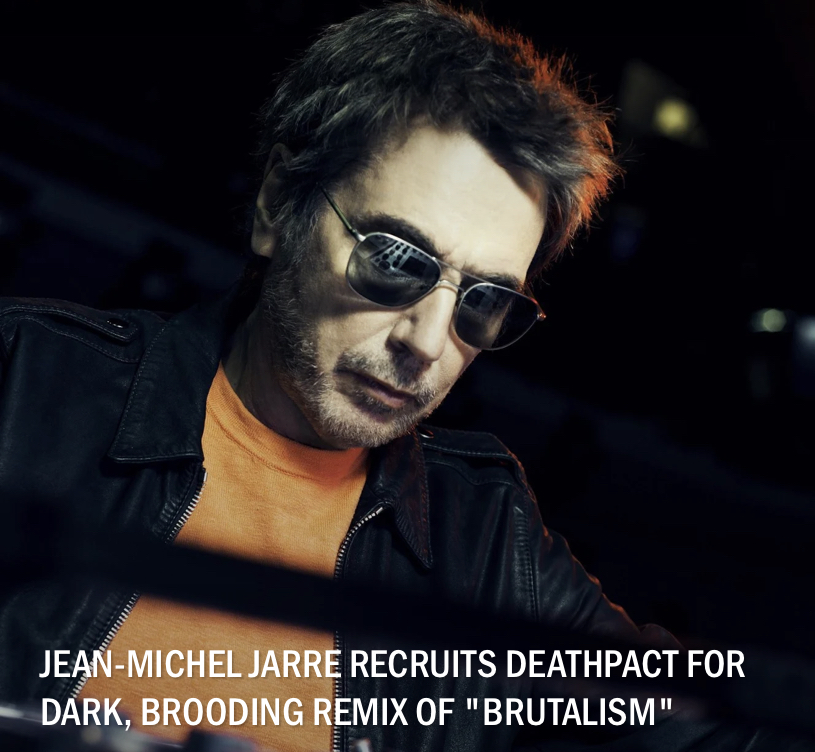
Jeans, jacket and dark glasses, Jarre is exalted for the project that links the past and the future of electronics. It goes from the genesis of electroacoustics - the tribute to the mentor Pierre Henry, to the movement of musique concrète, and to that choreography of uncoded sounds - to the new sound horizon: the multi-channel and 3D binaural used for the first commercial publication of the genre. With headphones, Oxymore is an immersive work where the listener is at the center, surrounded by sounds that walk on the back of the neck like ants. "It is not just a new listening experience, for everyone, not for the sophisticated and privileged" he explains. "It is just another way of composing, putting sound objects in space".
If that wasn't enough, the tracks have remixes (also by Martin Gore and Brian Eno) and come alive in Oxyville: "A virtual metropolis of music where you can play concerts, invite artists and hold masterclasses". It will play to us in avatar format. Oxymore is closer to the experimental Zoolook of 1984 than to that Oxygène of 1976 which with 12 million copies sold brought electronics to the general public, and live the rave matrix "But exactly as then" assures Jarre "we are at beginning of a movement ".
Can you give me your definition of music?
"For me it falls into the category of addictions. It is an unsatisfied search, a mirage you tend to without ever reaching it. What you have in your head and what comes out are two parallel lines that you try to converge. The oxymoron par excellence".
"The era in stereo is over, which is an illusion, a fiction to create the sense of space. In nature we hear at 360 °, the noises come from our side, behind us. The binaural system gives us this three-dimensionality. To reinforce it there is virtual reality, closer to music than to video games because the first sense involved is not sight. It is hearing that perceives total immersion ".
Why the need to set the stages of electronic music today?
"In the album I pay homage to the European approach to modern music and I hand this grammar to the new generation. Electronic music has nothing to do with the America of jazz, blues or rock. And it was not born in Detroit as many people think now, but in our continent, also in Italy, with L'arte dei Rumori by Luigi Russolo, a kind of science fiction writer in music. And in France, at the end of the 1940s, with the Groupe de Recherches Musicales by Pierre Schaeffer and Pierre Henry . They are the first DJs in history. Today's samples, sound design, derive from them. Seminal, and unfortunately not as popular as John Cage ".
The album was conceived on Radio France, where he met them in 1968. How did he get there?
"I studied classical music, I played in a rock band, then I was struck by these alchemist smiths who conceived music not as notes but as sounds. The difference between noise and music was in the composer's intention, in his hands. They mixed elements that apparently they have nothing to do with each other, the sound of rain with a clarinet. Silence? As relevant as the rest. They were surrealists, provocateurs, iconoclasts. I too became a hijacker. "
Were you considered pop among the avant-garde?
"I've always been in a schizophrenic situation. I wasn't intellectual like the others. Pure experimentation was too cerebral for me. I love melody, the sensual element, sharing, so I set myself up as a bridge between experimentation and pop culture. . Yet Oxigène certainly could not be defined as commercial ".
He had to play alien in 1976.
"Nobody wanted to publish it. They said: it has no rhythm, there is no voice, plus you are French. When it came out, people were sending back vinyl, complaining about the noises, the manufacturing defects. Today it is a classic. name we give to what will be popular thirty years later ".
Would Oxymore call it a pop record?
"In the sense that it is a sound experience that everyone can do. There are danceable pieces, delicate parts, others violent, and then, of course, faithfulness to my experimental roots. For example, one day I had the window open and out of nowhere it appeared. the sound of a jazz drummer rehearsing from a distance, lost in space. I captured it and put it in. "
Like a polaroid. On the other hand, for Henry concrete music was closer to photography than to music. He compared his profession to that of a monk. Do you agree?
"The musicians share the stage, they have an orchestra next to them, but the composer is solitary, he looks more like a painter, a writer. The studio is an atelier where he gets sounds and shapes them like a sculptor does with stone".
The cover of Oxymore: will be released with Sony on October 21 on cd, vinyl, digital, in stereo and in binaural audio
In two songs there is the voice, the breath of his mentor. How much is there?
"We were supposed to work together on my Electronica record, then he died and left me some material. I used less of it than I thought, but without it the project would never have happened. Pierre Henry is a ghost on the record. I betrayed him enough. to make him happy ".
Did the absence of his father influence your way of thinking about music? After all, absence forms a space to be filled.
"Probably I started creating to occupy that space of pain, and doing things antithetical to his. I was angry with him. He had left my mother alone. At night I feared something would happen to her, so we became protective of each other. the other. Not a couple, but a duo. But that's the way it goes. Life puts cards in your hand and you play them with the rules you give yourself. Now that I think about it, my father's absence also has positive sides " .
With his father Maurice, three-time Oscar-winning composer (Getty Images)
(note from me: wrong, this is Francis Dreyfus

)
Which?
"It allowed me to find my breath as an artist. Growing up in the shadow of someone so great would have inhibited, held back, or created problems. The same ones my children have. Especially the youngest, David, who is a magician. . It took time to find harmony with the public figure of mine and his mother Charlotte (Rampling, his ex-wife ed) ".
When he started, electronics seemed like a ramp to the cosmos. What was the future imagined as a young man?
"In the '60s and' 70s we had a positive vision of it. For us, the 2000s would have been perfect, in terms of opportunities and social justice. Then it crashed. I hope again with the metaverse. It can be sustainable, and we will survive the twenty-first century only if we establish harmony between ecology and technology. And if we no longer separate culture and technology. New dizziness will arise from young people, I am optimistic ".
However, Oxymore's electronics are sometimes dark, more material and dystopian than cosmic.
"Each track teleports into a different atmosphere, in a neighborhood of the metropolis of Oxyville. There are also gardens, but the piece Brutalism, for example, is linked to the apocalyptic zone, to the big bang of techno after the fall of the Berlin wall, in the rubble of chaos. It sounds like a World War II bunker. "
His mother France Pejot was in the French Resistance. Lyon named a street after her.
"She was taken by the Nazis and deported to a concentration camp. She escaped three times. She shared her experience to testify, to prevent it from happening again, but she didn't tell me too much about it. A little to protect me from the horrors, a little out of humility. . She thought she had done only the right thing, but for me she is a heroine. Look what a normal mother has managed to do. "
What teaching did she leave you?
"Never confuse the Nazis with the Germans, the ideology with the people. When they invited me to play in places where freedom was not guaranteed, it was she who pushed me: you have to go otherwise collaborate in the alienation of that people, in their radicalization, and is punished twice ".
Is that why you accepted live shows in Moscow, China and Saudi Arabia?
"Of course, I don't believe in boycotts. Culture is a Trojan horse. Broaden your mind, pacify souls. I would also go to Korea, Iran, without being complicit in dictatorships. If anything, close to those who suffer from them."
In 1981 you were the first Western artist in China after Mao. What memory does she have?
"Like being on the moon. The country wanted to show that it was open to the rest of the world but the technology was inadequate. We needed equipment and Bernardo Bertolucci, who was shooting The Last Emperor in the Forbidden City, lent it to us. He too was in trouble. He gave it to us. the power generators, we gave them some lights. You wouldn't think so, but behind my great shows, there was often the Latin art of getting by ".
Even in Egypt? On December 31, 1999, he took The 12 Dreams of the Sun between the pyramids.
"Worse than in China. My group worked for months in the desert, inventing solutions. President Mubarak said to me: Extraordinary the show, and even more extraordinary that he managed to do it in my country: but how did he do it?".
That's how? They were crazy feats.
"In the beginning, believe me, it was out of necessity. Seeing a guy at the synthesized and on stage for two hours was not at all exciting. means of my time: lasers, videos, lights. As you can see, limits are resources ".
Oxygène, in effect, composed it with a broken mellotron.
"Exactly. And even earlier, when my grandfather gave me a tape recorder, I stumbled upon certain sounds wrongly, sending them backwards. Then as a boy I was obsessed with the warmth of American records. Where did it come from? In Europe, fine electronics came out, I discovered that we, impoverished by the war, had different cables and voltages. From this limit, a unique sound was generated. The narrow grid in which you have to move, activates the imagination. French and Italians know something. "like Cinecittà compared to Hollywood. Take Fellini. He never knew when he would have the money to finish his films and how he fared is history of cinema".
Did you meet him?
"He told me two fundamental things. First of all:" Jean Michel, I thought I was making different films but, if I look back, I realize that I have always done the same ". It is true for every artist. A career is the declination of the same obsession".
The second thing?
"He told me:" I prefer to create the false sea, with the towels and the fans, because it represents my idea of the sea. "For me it is the same. I prefer to recreate the sound of the wind, rather than record it. It is more poetic".
Is it true that Fellini asked you to compose for a film of him?
"Yes, Nino Rota had recently died and I refused, because they were an untouchable couple. I consider Rota a Beethoven of our times".
What limits has the metaverse 'given' to you?
"We are still in its Middle Ages, the graphics are childish, squared, it looks like Lego. I sharpened my wits and created a constructivist Oxyville, Bauhaus type, in black and white, halfway between Metropolis and Sin City. It seems the aesthetic choice of those who it has many possibilities, and it is the opposite ".
Careful that Zuckerberg doesn't steal the idea.
"We Latins are the ones used to getting by with what is there! Joking aside, it is urgent to create a European metaverse, a cloud that makes us independent from Asia or American soft power. Today, to use virtual reality, we have to turn to their distribution platforms, pay a lot. Tomorrow they could even censor for ideological reasons or colonize us digitally. We need the means to defend and promote our worldview ".
Isn't virtual reality an escape, a way to take even less interest in what surrounds us?
"It depends on how we use it. I don't see it as an abandonment of reality, but as an extension of it. Like the book, which was perhaps the first virtual reality object in history. And then it will help creatives."
How?
"It is a democratization for those who are geographically cut off or have disabilities. Furthermore, the metaverse is an opportunity to get back into possession of our works. Intellectual property has disappeared with the free offer. Producers, composers, arrangers, on digital platforms do not come Not even mentioned. Everyone gets money on music, except those who create it. The system needs to be changed, it's my battle. "
Can you give me your definition of music?
"For me it falls into the category of addictions. It is an unsatisfied search, a mirage you tend to without ever reaching it. What you have in your head and what comes out are two parallel lines that you try to converge. The oxymoron par excellence".
On the Friday of October 7, 2022