https://www.rollingstone.fr/jean-michel ... ctronique/
[Google translate]
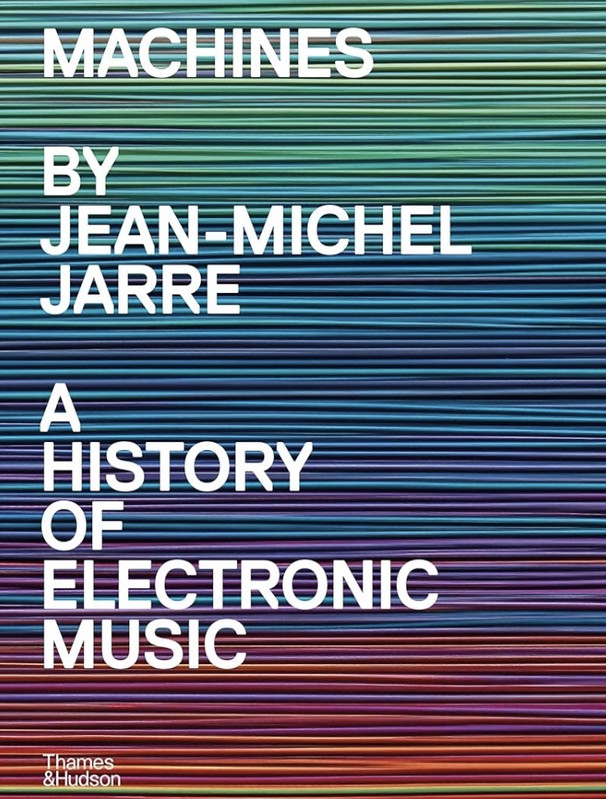
Jean-Michel Jarre publishes Machines, a book on electronic music
Jean-Michel Jarre is publishing "Machines", a monumental art book that traces more than a century of electronic music, to be released in October 2026 by Éditions du Chêne.
At a time when electronic music permeates almost every contemporary genre, one of its most iconic pioneers is undertaking to tell its story through the lens of his instruments. Jean-Michel Jarre, the French composer with over 85 million records sold, will publish * Machines: A History of Electronic Music * in October 2026 , a 368-page book that aims to become the definitive illustrated work on the subject. Co-published by Thames & Hudson for the international market and by Éditions du Chêne (Hachette Livre group) for France, this beautiful book will be released to coincide with a symbolic anniversary: the fiftieth anniversary of * Oxygène *, the album that changed everything in 1976.
From futuristic sounds to synthesizer pads
The story of Machines doesn't begin in a recording studio, but in early 20th-century Italy. In 1913, the painter and composer Luigi Russolo published his Futurist manifesto, The Art of Noises , a visionary text that laid the foundations for music freed from classical harmonic conventions. It is this seminal document that Jarre chose as the starting point for his epic, then tracing a chronological thread that runs through Surrealism, the Bauhaus, radio experiments between the wars, and the first machines for producing electronic sound.
The book draws on the artist's personal collection, one of the world's largest collections of electronic and electroacoustic instruments. More than eighty machines are presented and described in detail, from the iconic ARP 2500 to the custom creations and unique pieces Jarre has amassed over five decades of his career. Each instrument is placed within its historical, technological, and musical context, offering the reader an intimate understanding of how these machines shaped the sound of their era.
“Electronic music is a fundamentally European genre, born from Surrealism and the Bauhaus, then shaped by radio ,” the book's introduction reminds us. It's a perspective Jarre has championed for decades, and one he documents here with archival precision.
Oxygen, the album that started it all
It's impossible to talk about Jean-Michel Jarre without mentioning Oxygène . Recorded in 1976 in a makeshift studio set up in his Parisian apartment—which he then shared with actress Charlotte Rampling—this instrumental album was conceived with modest means but boundless ambition. Using an ARP 2600, an EMS VCS 3, an EMS Synthi AKS, an RMI Harmonic Synthesizer, an Eminent 310 U, and a Farfisa Professional, Jarre composed six pieces that form an organic whole, a kind of sonic journey between cosmic melancholy and hypnotic pulsations.
The result exceeded all expectations. Oxygène sold over twelve million copies worldwide, propelling its creator to international stardom. The track " Oxygène (Part IV)" reached number four on the UK Singles Chart, a remarkable achievement for an instrumental electronic music track at the time. The song was later featured in the soundtrack of the video game Grand Theft Auto IV (2008) and in the BBC television film Micro Men , a testament to its enduring presence in popular culture. The album became one of the best-selling records in the history of electronic music and established Jarre as the face of a genre then considered marginal.
In 2026, this album celebrates its fiftieth anniversary—half a century that has seen electronic music move from the margins to the center of the global music scene. The anniversary will be celebrated not only with the release of Machines , but also with a series of European concerts. Jarre will perform in Radom, Poland; Athens; the Noches del Botánico festival in Madrid; the FAR Festival in Valencia; Starlite Occident in Marbella; Toulouse; and Modena, before a particularly anticipated event: his appearance as guest of honor at the thirtieth edition of the Amsterdam Dance Event (ADE), from October 21 to 25, 2026, where he will present an immersive concert entitled Oxygène & Beyond: A Sonic Journey .
A collection of extraordinary instruments
The heart of Jean-Michel Jarre's Machines lies in the presentation of Jarre's personal collection. This collection is not limited to the famous synthesizers associated with his best-known albums. It encompasses rare instruments, prototypes, custom-built machines, and pieces that each tell a part of the history of electronic instrument making.
Among the key pieces of equipment, the ARP 2600 holds a central place. This instrument, which Jarre has used since his early days, has become one of the symbols of his signature sound. The EMS VCS 3, his very first synthesizer, also features prominently, as does the Eminent 310 U, the analog organ whose instantly recognizable pads open several of his albums. The book also details instruments less known to the general public but essential to the evolution of electronic sound, from the first machines of the analog era to digital technologies, including the Fairlight CMI, one of the first samplers, and the beginnings of MIDI and sequencing software.
In 2019, Jarre had already offered a glimpse of his collection by presenting an "imaginary studio" at the Electro exhibition at the Philharmonie de Paris. Machines goes far beyond this appetizer, offering unprecedented access to instruments that few people have had the opportunity to see up close.
From the futuristic manifesto to artificial intelligence
The ambition of Machines goes beyond a simple catalogue of instruments. The book aims to be a complete history of electronic sound, from its origins to its most contemporary horizons. After laying the foundations with Italian Futurism and the European avant-garde, the book traverses the major stages of the genre: the studios of Pierre Schaeffer's musique concrète in the 1940s, the emergence of the first commercial synthesizers in the 1960s, the explosion of popular electronic music in the 1970s and 1980s, and then the techno and house revolution of the 1990s.
But Jarre doesn't dwell on the past. The final chapters of the book explore the territories that electronic music is currently occupying and will occupy in the future: artificial intelligence as a compositional tool, virtual reality as a performance space, and immersive, spatial audio as a new frontier of listening. These are all themes on which the French composer has publicly taken a stand in recent years. In an interview with the Belgian magazine Moustique in April 2025, on the eve of a concert at the Place des Palais in Brussels, he stated unequivocally that "the new Billie Eilish will be generated by Artificial Intelligence ." A deliberately provocative statement, but one that reflects the clear-sightedness of an artist who has observed for half a century the technological upheavals that have profoundly transformed the way music is created, distributed, and consumed.
This ability to combine memory of the past with projection towards the future is one of Jarre's trademarks. At 77, he remains one of the few artists of his generation to actively engage in contemporary technological debates, rejecting the nostalgic stance sometimes associated with pioneers.
Equinox's legacy and the conquest of the world
While Oxygène launched his career, it was Equinoxe , released in 1978, that confirmed Jean-Michel Jarre was no flash in the pan. With this second commercial success, the artist established a uniquely recognizable sonic signature: captivating rhythmic sequences, meticulously crafted atmospheric textures, and an ability to create soundscapes that evoke both interstellar space and the ocean depths. The album sold millions of copies and cemented Jarre's credibility on the international stage.
The following decade saw the artist explore new territories. Magnetic Fields (1981) marked the integration of the Fairlight CMI, one of the very first digital samplers, into his creative arsenal. Zoolook (1984) pushed experimentation further by incorporating vocal samples from twenty-five different languages, a bold conceptual approach for the time. Then came Rendez-vous (1986), whose final piece, Last Rendez-Vous (Ron's Piece) , carries the weight of tragedy. Astronaut and saxophonist Ron McNair was to record a live saxophone solo from space during his mission aboard the space shuttle Challenger . The explosion of the shuttle on January 28, 1986, which claimed the lives of all seven crew members, transformed this project into a posthumous tribute.
Each of these albums represents a step in the technological evolution that Machines sets out to document. The book doesn't simply photograph instruments in a studio; it recounts how each new machine opened up unprecedented creative possibilities, and how Jarre, among others, was able to exploit them to push the boundaries of sound. This is also what distinguishes Jean-Michel Jarre's Machines from a mere catalog of synthesizers: the book is imbued with an authorial vision, that of a musician who experienced firsthand the transformations he describes, and who can attest to how each technological advancement altered not only the sound, but also the very act of the composer interacting with their machine.
The record-breaking man
To grasp the magnitude of the figure behind Machines , it's worth recalling a few figures. Jean-Michel Jarre holds several Guinness World Records for the largest outdoor audiences. In 1979, he drew over a million spectators to the Place de la Concorde in Paris, an unprecedented event at the time. In 1986, he repeated the feat in Houston, USA, in collaboration with NASA and the city, before more than a million people. On July 14, 1990, he broke his own record at La Défense with 2.5 million spectators, at a concert marking the close of the bicentennial celebrations of the French Revolution. In 1997, his concert in Moscow attracted an estimated 3.5 million people, a figure that remains one of the largest audiences ever recorded for an outdoor musical event.
Beyond his record-breaking achievements, Jarre has opened diplomatic doors through music. In 2024, he was still electrifying Samarkand for UNESCO . He was the first Western musician authorized to perform in the People's Republic of China, a historic concert that helped establish him as a global cultural figure, extending far beyond the realm of music.
His discography includes twenty-two studio albums, and his cumulative sales exceed 85 million copies. These figures make him one of the most exported French artists in history, and one of the most influential names in electronic music worldwide. His career is as much an artistic achievement as a human adventure, and Machines aims to capture its essence through the instruments that made it possible.
A book conceived as a visual fresco
The format chosen for Jean-Michel Jarre's * Machines* is not insignificant. The beautiful book, with its size and high-quality printing, highlights the visual dimension of the electronic instruments—these often spectacular machines with their exposed cables, buttons, screens, and circuits. Éditions du Chêne, renowned for its art and heritage books, brings its expertise in high-end publishing to this project.
Thames & Hudson, a leading international publisher of art and design books, is handling global distribution. The simultaneous release in several countries—October 8, 2026, for the English edition and October 14 for the French edition—demonstrates the project's commercial and cultural ambition. The book is already available for pre-order from major online bookstores, with ISBN 978-2-8123-2260-0 for the French edition and 978-0-500-03150-6 for the international edition.
In a music book market often dominated by biographies and critical essays, Machines occupies a unique niche: that of the art book, halfway between an illustrated encyclopedia and a firsthand account. This positioning should appeal to both electronic music enthusiasts and lovers of sound design and visual culture. The French edition is priced at €39.90, a price consistent with the segment of illustrated art books of this scale.
A pioneer facing the new generations
Electronic music in 2026 is nothing like it was in 1976. The tools have changed, the aesthetics have fragmented into dozens of subgenres, and today's producers often work on a simple laptop where Jarre needed an entire room of equipment. Yet, the French composer's influence remains palpable, even among artists who didn't experience the analog era. Producers like Gesaffelstein, Perturbator, and Carpenter Brut, leading figures in the contemporary French electronic scene, claim an aesthetic legacy rooted in the dark textures and hypnotic sequences that Jarre helped popularize.
Indeed, one of the merits of Jean-Michel Jarre's book, * Machines* , is that it re-establishes this often-forgotten lineage. By documenting the instruments and techniques that founded the genre, the book offers new generations direct access to the DNA of the music they make. It reminds us that behind every software plugin, behind every virtual synthesizer preset, lies a physical machine whose potentiometers someone, somewhere, must have turned by hand to coax a new sound from it. At a time when the democratization of digital tools allows anyone to produce electronic music from their bedroom, this reconnection with the materiality of the original instruments takes on an almost philosophical dimension.
As he explained in an interview with Rolling Stone France , Jarre has always been keen to reach out to younger generations with his Electronica project (2015-2016), a double album of collaborations with artists as diverse as Gesaffelstein, M83, Tangerine Dream, Massive Attack, Primal Scream, and Armin van Buuren. This project already demonstrated the artist's desire to forge connections between eras and aesthetics, an approach that Machines extends to the publishing realm.
2026, the year of Jean-Michel Jarre
The publication of Jean-Michel Jarre's Machines comes at a particularly busy time for him in 2026. Between the European tour celebrating the fiftieth anniversary of Oxygène , the landmark concert at the Amsterdam Dance Event, and the release of this beautiful book, the artist is juggling multiple projects with an energy that defies generational conventions.
This flurry of activity is more than just a cleverly orchestrated PR campaign. It reflects Jarre's unique place in the global music scene: that of an artist who has spanned five decades without ever ceasing to create, innovate, and question the boundaries between art, technology, and live performance. With Machines , he adds a new dimension to his legacy: that of the historian, the keeper of memory, the one who documents a genre he helped to invent.
For electronic music enthusiasts, vintage instrument collectors, and those curious to understand how a few cables and circuit boards sparked a global cultural revolution, Machines is shaping up to be an unmissable event in the fall of 2026. A book that, like its author, refuses to choose between the past and the future.
Machines: A History of Electronic Music by Jean-Michel Jarre will be available on October 14, 2026 from Éditions du Chêne (€39.90) and from October 8, 2026 from Thames & Hudson for the international edition.
The editorial team.